Hope to see you there!


Showing posts with label lynette yetter. Show all posts
Showing posts with label lynette yetter. Show all posts
Sunday, October 1, 2023Friday, February 17, 2023Finalist for the PEN Award for Poetry in Translation! I'm thrilled beyond words that my bilingual book Adela Zamudio: Selected Poetry & Prose was selected as a Finalist for the PEN Award for Poetry in Translation! PEN America awards are the Oscars of the U.S. literary world. Of course I (and my Fuente Fountain Books' editors Tania Cano and Michael Favala Goldman) will travel to NYC for the March 2nd gala Awards Ceremony! Here's more about the book: First book in English showcasing the life and writings of Bolivia's most celebrated writer and educator, Adela Zamudio. Her birthday is a national holiday in Bolivia. Self-taught, Zamudio was the mother of feminism and women's education in Bolivia, and was active for Indigenous People's rights. The President of Bolivia crowned her with gold laurel leaves in honor of her cultural contributions. Adela Zamudio: Selected Poetry & Prose, translated from the Spanish by Lynette Yetter, presents a bilingual overview of Zamudio's work, much of which was previously untranslated. Several chapters, including the Prolog by Bolivian Zamudio scholar Virginia Ayllón, outline Zamudio's biography and the cultural context in which she wrote. Adela Zamudio's celebration of lesbian love and her ironic cultural critiques continue to resonate today.  Friday, January 11, 2013The Dragon King's Daughter; A 9-minute SGI Buddhist comedy for 6 - 7 actors
By Lynette Yetter
Inspired by The Lotus Sutra and Its Opening and Closing Sutras, translated by Burton Watson, Soka Gakkai, Japan, 2009, pp 224-228.
CAST OF CHARACTERS:
Shakyamuni Buddha
Bodhisattva Wisdom Accumulated
Fabric waver 1
Fabric waver 2 / Lotus bearer Bodhisattva Manjushri (aka M Dude)
Dragon King’s Daughter
PROPS:
-- shimmery blue fabric, approximately 1.5 yards x 3 yards
-- 2 plastic headbands with a topknot of fake hair fastened to the top of each
-- cardboard cutout of giant lotus flower with LOTS of petals, big enough to appear to be a vehicle for a person to ride on
-- a large paper (approx. 5- to 10-foot long white butcher paper, covered with images of lotus flowers)
FADE IN:
SHAKYAMUNI
In the future ages if there are good men or good women . . .
BODHISATTVA WISDOM ACCUMULATED
Excuse me, Shakyamuni, what is that thing on top of your head?
SHAKYAMUNI
This protuberant knob of flesh on the crown of my head is like a topknot of hair, is it not? It is one of my 32 characteristics as the buddha.
BODHISATTVA WISDOM ACCUMULATED
Cool!
Shakyamuni CLEARS her throat and prepares to once again begin her speech.
SHAKYAMUNI
In the future ages if there are good men or good women who, on hearing the Devadatta Chapter of the Lotus Sutra of the Wonderful Law . . .
BODHISATTVA WISDOM ACCUMULATED
What is the Devadatta Chapter?
SHAKYAMUNI
It’s what we are in right now. We floated up off of Eagle Peak into outer space in the Ceremony in the Air that transcends the framework of time and space. You and I and everyone here are characters in the Devadatta Chapter. Does that answer your question, Boddhisattva Wisdom Accumulated?
BODHISATTVA WISDOM ACCUMULATED
Thanks!
(Beat)
I just accumulated some more wisdom! Or was that knowledge? Never mind. Please continue, Shakyamuni.
SHAKYAMUNI
As I was saying,
(Beat)
In the future ages if there are good men or good women who, on hearing the Devadatta Chapter of the Lotus Sutra of the Wonderful Law, believe and revere it with pure hearts and harbor no doubts or perplexities . . .
BODHISATTVA WISDOM ACCUMULATED
Believe with a pure heart. That’s like faith, right?
SHAKYAMUNI
Of course.
BODHISATTVA WISDOM ACCUMULATED
And we can substitute faith for wisdom, right?
SHAKYAMUNI
Of course.
BODHISATTVA WISDOM ACCUMULATED
Then I AM accumulating wisdom, and not just knowledge, because I DO believe with a pure heart!
SHAKYAMUNI
That’s why you are Bodhisattva Wisdom Accumulated. Now listen-up so you can accumulate some more wisdom.
BODHISATTVA WISDOM ACCUMULATED
Okay.
SHAKYAMUNI
. . . will never fall into the realm of hell, hungry spirits or beasts . . .
BWA puts his hand in the air and waves it to signal that he has a question.
SHAKYAMUNI (CONT’D)
You have a question?
BODHISATTVA WISDOM ACCUMULATED
Is the realm of hell, hungry spirits or beasts the lowest three of the 10 Worlds?
SHAKYAMUNI
Yes.
BODHISATTVA WISDOM ACCUMULATED
But, I thought that with the Mutual Possession of the 10 Worlds and Three Thousand Realms that all of the worlds are mutually inclusive. So, even the world of Buddhahood contains Hell, Hungry Spirits and Beasts. If that is true, how can those good men and good women not experience those worlds? I’m confused.
SHAKYAMUNI
Good point. We’ll leave that to Tien Tai to sort out. For now, just bear with me, okay, so we can continue with this play?
BODHISATTVA WISDOM ACCUMULATED
A play? I thought we were in the Ceremony in the Air?
SHAKYAMUNI
It’s both. We are in a play ABOUT the Ceremony in the Air. And the playwright is being creative with the tale. Now, don’t you want to know what happens next?
BODHISATTVA WISDOM ACCUMULATED
Sure!
SHAKYAMUNI
Okay then, there’s just a little bit more to my speech. Can you wait that long?
BODHISATTVA WISDOM ACCUMULATED
I’m all ears. Go ahead!
SHAKYAMUNI
Now where was I . . . Will never fall into the realm of hell, hungry spirits or of beasts, but will be born in the presence of the buddhas of the ten directions, and in this place where they are born they will constantly hear this sutra.
BODHISATTVA WISDOM ACCUMULATED
Don’t those good men and good women get to do anything else beside constantly hear this sutra?
SHAKYAMUNI
This is a parable, a metaphor for the mysterious workings of life. Of course they get to do other things.
(Beat)
Remember, you promised to wait until I finished the speech.
BODHISATTVA WISDOM ACCUMULATED
Oh yeah. Sorry. Go on.
SHAKYAMUNI
If they are born among humans or heavenly beings, they will enjoy exceedingly wonderful delights.
BODHISATTVA WISDOM ACCUMULATED
Like ice cream?
SHAKYAMUNI
Even better. Now please wait until I finish.
BODHISATTVA WISDOM ACCUMULATED
Okay.
SHAKYAMUNI
And if they are born in the presence of the buddhas, they will be born by transformation from Lotus Flowers.
Silence. A long pause. BWA is content and mellow, enjoying listening attentively, waiting for the speech to continue.
SHAKYAMUNI (CONT’D)
That’s it. I’m done. That’s the speech.
BODHISATTVA WISDOM ACCUMULATED
(Applauds) Great speech!
(Beat)
Well, I’ve got some other things to be doing. Can I go now?
SHAKYAMUNI
Good man, wait a little while. There is a bodhisattva named Manjushri whom you should see. Debate and discuss the wonderful Law with him, and then you may return to your homeland.
BODHISATTVA WISDOM ACCUMULATED
Okay.
Two Fabric Wavers run out carrying the blue fabric onto the stage from right to left, with Bodhisattva Manjushri hidden behind, ducking down and running along at the same speed as the Fabric Wavers. The Fabric Wavers are rippling the blue fabric as if it is the ocean. Their bodies are hidden behind the fabric. They stop. Manjushri (still hidden behind the fabric) has a giant lotus flower made from cardboard fastened to him, as if it was his chair or magic carpet or his space ship that he can zoom around on. As the Fabric Wavers continue to ripple the fabric to look like ocean swells, Bodhisattva Manjushri stands up. The Fabric Wavers slowly kneel, lowering the fabric to reveal Bodhisattva Manjushri on his Lotus vehicle.
BODHISATTVA WISDOM ACCUMULATED (CONT’D)
Wow! Bodhisattva Manjushri is rising out of the sea and floating in the air on a giant lotus flower with a 1,000 petals! Where did you come from, Dude?
The Fabric wavers drag the fabric and exit Stage Right. Off stage they set down the fabric and pick up cardboard cutouts of many Lotus flowers.
M DUDE
My real name is Bodhisattva Manjushri but you can call me M Dude. I have just come from the Palace under the sea of Dragon King Sagara.
BODHISATTVA WISDOM ACCUMULATED
Cool!
M Dude steps out of his Lotus vehicle. Bows to Shakymuni, then goes to side of Bodhisattva Wisdom Accumulating.
BODHISATTVA WISDOM ACCUMULATED (CONT’D)
When you went to the palace of the Dragon King, how many living beings did you convert?
M DUDE
The number is immeasurable, incapable of calculation. The mouth cannot express it, the mind cannot fathom it. There will be proof. Wait a moment.
BODHISATTVA WISDOM ACCUMULATED
(speaking to the audience directly in a dramatic whisper) Everyone wants me to wait a moment!
Lotus Bearer enters carrying a large paper covered with images of Lotus flowers, as if the Lotus flowers are more flying carpets carrying more people. Lotus Bearer walks around moving the Lotus flowers in a way that looks like they are flying.
BODHISATTVA WISDOM ACCUMULATED (CONT’D)
Wow! Look at those countless bodhisattvas seated on jeweled lotus blossoms emerging from the ocean and coming here suspended in the air above Eagle Peak.
M DUDE
All of these beings have been converted and saved by me. They carried out all the bodhisattva practices, which are too numerous to mention here in this short play.
BODHISATTVA WISDOM ACCUMULATED
You are of great wisdom and virtue, brave and stalwart, you have converted and saved immeasurable beings. Now those in this great assembly, as well as I myself, have all seen them. You expound the principle of the true aspect, open up the Law of the single vehicle, broadly guiding the many beings, causing them quickly to attain enlightenment.
Lotus bearer EXITS Stage Right.
M DUDE
When I was in the ocean I constantly expounded the Lotus Sutra of the Wonderful Law alone.
BODHISATTVA WISDOM ACCUMULATED
This sutra is very profound, subtle, and wonderful, a treasure among sutras, a rarity in the world. Are there perhaps any living beings who, by earnestly and diligently practicing this sutra, have been able to attain buddhahood quickly?
M DUDE
There is the daughter of the dragon king Sagara.
BODHISATTVA WISDOM ACCUMULATED
What is her name?
M DUDE
What?
BODHISATTVA WISDOM ACCUMULATED
What is her name?
M DUDE
Her name is “the Dragon King’s Daughter”.
BODHISATTVA WISDOM ACCUMULATED
But, the Dragon King has a name. You told me so yourself. His name is Sagara. What is his daughter’s name?
M DUDE
She doesn’t have a name. After all, she is female and only 8 years old and a reptile to boot. Who cares if she has a name? We’ll just call her the Dragon King’s Daughter.
BODHISATTVA WISDOM ACCUMULATED
Hmmm . . . I still want to know her name. If she doesn’t have a name, we should give her one - like how Nichiren Daishonin gave names to his formerly-nameless female followers. He called them nuns and gave them beautiful names. I think we should name her "Momo!"
M DUDE
Can I get on with the story?
BODHISATTVA WISDOM ACCUMULATED
Sure. Go ahead.
M DUDE
Anyways, the Dragon King’s Daughter has just turned eight years old. Her wisdom has keen roots and she is good at understanding the activities and deeds of the sense organs of living beings.
BODHISATTVA WISDOM ACCUMULATED
What does that mean?
M DUDE
The translation is kind of complicated, what with different cultures and all. Let’s just say that she is really wise and understands everything and everybody. She is capable of achieving enlightenment.
BODHISATTVA WISDOM ACCUMULATED
And she is only 8 years old? Wow! That’s hard for me to believe.
M DUDE
Why?
BODHISATTVA WISDOM ACCUMULATED
When I observe Shakyamuni, I see that for a really really long time - like forever and ever, he carried out harsh and difficult practices, accumulating merit, piling up virtue, seeing the way of the bodhisattva without ever resting. There is not a speck of the universe where he has not sacrificed his body and life for the sake of living beings. Only after he had done that was he able to complete the way of enlightenment.
Before his words come to an end, the Dragon King’s Daughter (who has the prop -- a headband with topknot of hair -- hidden somewhere on her person) ENTERS Stage Right as the Fabric waver runs around her with the fabric in such a way as to make it seem that the Dragon King’s Daughter is appearing magically in the assembly. When she is in front of Shakyamuni, she bows to him, and so does the fabric bearer (as if the fabric bearer is her shadow). The fabric bearer from this point on stays near the Dragon Kings Daughter like a shadow, holding the fabric bundled in her arms.
DRAGON KING’S DAUGHTER
Having heard his teachings, I have attained enlightenment -- the Buddha alone can bear witness to this. I unfold the doctrines of the great vehicle to rescue living beings from suffering.
BODHISATTVA WISDOM ACCUMULATED
You know what Shariputra would say, if we had enough actors to have Shariputra present?
DRAGON KING’S DAUGHTER
What would he say?
BODHISATTVA WISDOM ACCUMULATED
He would say to you, and I quote, (clears throat), “You suppose that in this short time you have been able to attain the unsurpassed way. But this is difficult to believe. Why? Because a woman’s body is soiled and defiled, not a vessel for the Law. How could you attain unsurpassed enlightenment? The road to buddhahood is long and far-stretching. Only after one has spent immeasurable kalpas (that’s a really really long time like forever) pursuing austerities, etc etc etc can one finally achieve success. Moreover, a woman is subject to the five obstacles. 1. She cannot become a Brahma heavenly king. 2. She cannot become a king Shakra. 3 She cannot become a devil king. 4. She cannot become a wheel turning sage king. And 5. She cannot become a buddha.
(Beat)
How then could a woman like you be able to attain buddhahood so quickly?
The Dragon Girl cups her hands, miming holding a precious object.
DRAGON KING’S DAUGHTER
Do you see this precious jewel that is worth a major world system?
BODHISATTVA WISDOM ACCUMULATED
Yes.
The Dragon Girl mimes handing the jewel to Shakyamuni. He immediately accepts it.
DRAGON KING’S DAUGHTER
I presented the precious jewel, and the world-honored one accepted it. Was that not quickly done?
BODHISATTVA WISDOM ACCUMULATED
Very quickly!
DRAGON KING’S DAUGHTER
Employ your supernatural powers and watch me attain buddhahood. It will be even quicker than that!
The Fabric waver swirls the fabric around and around the Dragon King’s Daughter. Hidden by the fabric, the Dragon King’s Daughter fastens a topknot to her head, just like the topknot of Shakyamuni.
The Fabric waver drops the fabric. The Dragon King’s Daughter has her hands folded in prayer position and chants to the audience with a confidence of the entire universe in her heart.
DRAGON KING’S DAUGHTER (CONT’D)
Nam myoho renge kyo. Nam myoho renge kyo. Nam myoho renge kyo.
BODHISATTVA WISDOM ACCUMULATED
Wow! If you, a child, a female and a reptile can become a Buddha instantly by chanting Nam myoho renge kyo, anyone can do it!
Dragon King’s Daughter looks out to the audience and says -
DRAGON KING’S DAUGHTER
We all can become buddhas! Let’s do it, right now! Will you chant with us?
All the actors turn towards the gohonzon and chant in unison with the audience -
ALL
Nam myoho renge kyo. Nam myoho renge kyo. Nam myoho renge kyo.
THE END
Wednesday, December 5, 2012Book Review: Lucy Plays Panpipes for Peace
Book review by guest blogger, Tantra Bensko
Lynette Yetter’s novel draws from her own life when she went to the Andes, pulled by the sound of the panpipes as a tool for transformation. Yet it is fiction, in the way called for in David Shields’ Reality Hunger. It means more knowing she really did something truly audacious and death defying. Here, we get a glimpse of how close to reality it is, and how the fiction made it into the powerful book it is. “Hurtling through space and time, the blue orb was rapidly self-destructing. Vital fluids pumped out of its innards burned in orgies of greed. The vapors ate away its luminous ozone skin. Indigenous Elders, you might call them brain cells of wisdom, were ignored. New synapses of fiber optic cable and satellite rays rationalized the destruction as ‘progress.’ Chaos surged like a flooding river.” Thus begins the story in which Lucy goes to participate in the ancient culture of the Andes.  Her words continue to swell when she extends her viewpoint outward, such as “Each person, a black-clad spark of soul, pulled by the inexorable gravity of survival. Together the seething mass of humanity ran. In their black mourning clothes, they were like primordial darkness churning. The light of humanity in their hearts bound each to the other as if to birth a new galaxy of life, in Warrior Town.” It’s obvious Lynette knows how to write powerfully. I also appreciate how real and down-to-earth the language is, how honest and wholesome this book. It’s hip in a DIY kind of way, with Lynette doing a tour on bike for this book as activism inspiring others to follow their dreams and stand up for peace, and play. It also is a great example of what David Shields call for in his manifesto Reality Hunger, which is taking the world by storm now. Lynette Yetter’s Lucy feels real, and the events occurred in the way that anything occurs in our memories—as fiction–stories we’ve told ourselves repeatedly and bundled into plot packages. One of the things I like best is that she includes the vantage point of manifesting and finding our future—and doesn’t just include the times her intentions worked. Her idealism, naïve ideas of the simplicity of finding her heart’s desire are sweet, and ironic when faced with reality. She manages to keep her humor about the ups and downs that causes, though she feels such things very passionately, and they can shake her. Her naïve idealistic determination makes her follow the sound of pan pipes to Peru, where she plays in various venues, joining in with indigenous musicians, as she believes the sound can help create visions of harmony for others as it did for her. She believes she can make a difference to bring more peace to this world through them. But it’s just that quality, and her passionate empathy and love, that create the inspiring events of this book.  Lucy takes on oppression and segregation, pointing out the false flag of 911, the cultural imperialism of missionaries, the modern tendency to block people out of simply going out and camping under the stars, and she wonders at anomalies of government/military connections. In South America, she plays indigenous peasant music only recently made legal, and has no trouble associating with citizens in the Andes who disrespect unfair political authority, and encourages harmony in dangerous situations. Even in competitive traditions she fosters a sense of oneness. She acknowledges how magical the world is through synchroncities such as running into the man who wrote a song she was playing. Yet, this isn’t a treatise on creative visualization. The irony that can undercut such magic becomes obvious when she gets to know the song’s author. I love that combination. She’s not living out some formula, pretending it always works. So, when her intentions do manifest, her visions do come true, they are far more believable and powerful. We learn about Andean folklore, such as the respectful relationship of miners to the Tios, earth spirits who live underground. We also learn that kusillos are androgynous entities who bridge the known and unknown. And we follow closely: shocking international business practices, the role of civil disobedience in social progress, and the involvement of the U.S. in civil war. This book made me cry for a long time, tremble, and even shout out loud. David Shields would like her book. In his, Reality Hunger, which also came out in 2010, he claims “Most, perhaps even all, good work (or, okay, work that excited me) eludes easy generic classification: once we know it’s coloring entirely within the lines called 'novel' or 'memoir' or 'Hollywood movie,' I honestly don’t see how anything emotionally or intellectually interesting can happen for the reader. . . . Just as out-and-out fiction no longer compels my attention, neither does straight-ahead memoir.” I asked Lynette about the fiction/memoir interface: “My book and reality. It is heavily based on my own personal experience in Peru and Bolivia. In order to better tell the Truth, to express Reality, I chose to fictionalize my experiences. As an old hiking buddy and PhD in English once told me — fiction is where we express the deeper truths of life. In short, she said, ‘Fiction rocks!’ Lucy Plays Panpipes for Peace started out as pure memoir — emails sent to friends and first person stories I told at performance spaces in Los Angeles. But, it was too limiting to stick to chronological events and specific people. By fictionalizing reality I can lump many people into a single character who then becomes an archetype. And in that process, new characters – 100% fictitious – are sometimes born. My favorite is Aunt Bert. Aunt Bert came to me in a vision, you might say. I was riding in a bus along the shores of Lake Titicaca, when suddenly Aunt Bert appeared in my mind. She told me her life story. As I looked out the bus window at the scenery passing by, I was so moved by her life that I even cried at the sad parts. And when I got to where I was going, I wrote down what she had told me. That is how Aunt Bert came to be in the book. Speaking of reality – to me, Aunt Bert is one of the most real characters in the novel – yet she is 100% fictitious. Reality is so multi-dimensional. On one hand, it is the material world we can document with calendars and cameras and weights and measures. Yet it is also the invisible realm of the mysterious that animates all of life – is life. By fictionalizing the material world, I strive to reveal the deeper truths of what is invisible yet is the most powerful truth of all – our own lives.” David Shields asks “A character is either ‘real’ or 'imaginary’?. . . . To be alive is to travel ceaselessly between the real and the imaginary, and mongrel form is about as exact an emblem as I can conceive for the unresolvable mystery at the center of identity.”  I can feel this book in my heart. I know Lynette bravely accomplished the amazing feats in this story, yet it isn’t a heavy handed recitation of her travels, or an SGI tract, but a call to go into our deepest selves, to cry, because there is a reality there that the fictionalization allows to live in a moving way, inside of us. There is no boundary between story and life, Lucy and Lynette, or our hands, wet with tears, and the pages they turn, which catch the light of the sun, that is not separable from the light of consciousness. Saturday, November 17, 2012The Maple Leaf that Didn't want to Die
Once upon a time there was a maple leaf that didn't want to die.
"I have too much to live for!" it said. "I have lofty things to do, and stories to tell. There is a big change coming called Winter; I hear the fir trees whispering about it in their sylvan voices. I must see it and document it. For I am a Big Leaf and what I have to say is more important that anything in the world." The maple leaf was so persuasive that the squirrels who lived in the branches of the tree stopped their nut gathering and nest building and approached the maple leaf with a plan. "We'll help you," they said in their high squeaky voices. "We are experts and know everything -- for we have traveled hither and yon through-out the parklands; while you have only been on this one branch your whole life, since you were born last spring. We have studied for many years and therefore know far more than you do." The maple leaf was overjoyed that the squirrels understood his deepest desire and were altruistically going to help him live! He would not die! The squirrels twitched their whiskers and their tails as they consulted among themselves, then ran off in all directions -- except for Fluffy, Puffy, Muffy and Robert who stayed behind. "We are your medical administrators," they chirped in unison to the maple leaf. "We are the ones to fill out forms and process payments and file referrals and seek for donors and bill your insurance and hire new specialists and and and . . . " The maple leaf felt overwhelmed and perplexed by all of this information and terminology, but he told himself it was worth every sacrifice, for he would live! A squirrel returned, leading three stellar blue jays, each of whom had something in his or her beak. One had a shard of broken glass. Another had a needle from a hypodermic that some human had carelessly disposed of. The third held a long string, which dangled in loops and squiggles that danced in the wind. And then a fourth jay appeared. He carried a fresh sprig of fir needles. "The fir tree," announced Fluffy, "has generously volunteered to be a donor for this historic first-ever fir-to-maple transplant . . . " "Grafting," Robert corrected. "First-ever fir-to-maple grafting," Fluffy continued, with an irritated expression on his furry face. The facial expression would have been difficult for humans to decipher, but squirrels know the way of squirrels. Robert interpreted the irritation to mean his boss had a weak spot, a touch of insecurity. Robert was vying to move up the corporate ladder in this booming new medical industrial complex, and this triumph would carry him higher. His name would go down in history: "Robert, the inventor of the maple/fir graft!" Well, if you have ever worked in an office, or had occasion to visit one, you can imagine the rest from here. So I won't go into every little detail of the back-biting and money-grabbing and reputation-building that went on in the ever-growing community of squirrels, jays, then crows and moles and even the spiders who were trying to cash in on this. For of course everything had a price, and a reasonable profit to be made each time a product changed hands. The poor maple leaf who wanted to live took out a mortgage to pay for it all. And the "all" was an ever expanding total that got bigger and bigger. The fir sprig was grafted onto the maple leaf in an ingenious operation involving the cutting edge of technology. The maple leaf felt horrible, what with the holes poked in his stem and that resinous stuff gunking up his system. But, he kept telling himself that it was all worth it. After all, this was an issue of life or death. And death was to be avoided at all costs, no matter how arduous or painful. The squirrels' nest was filling with nuts that the squirrels themselves did not collect. "This medical administrating business is a heck of a lot more profitable than collecting our own nuts," they congratulated themselves in the evening, as they reclined in their nest made of already dead leaves, lined with the softest and spongiest moss, decorated with the rarest downy feathers, and filled with a hoard of only the finest nuts of select trees from all over the land. All of this luxury was brought to them, item by item, by subcontractors as their processing fee for getting certified as "Approved Providers." The squirrels rubbed their white bellies in contentment, and groomed each other's gray fur. "You're getting fat," Fluffy said. "So are you," Muffy said with a sniff and a frown. Since they no longer ran around to forage for their own food, and never left the big old maple tree, they needed more exercise. They needed a gym. So, ingenious crows built the administrators aerobic workout devices in the branches of the tree. For of course the squirrels were far too important and busy to leave their work of administrating the medical care in this dire life-or-death situation of the maple leaf that didn't want to die. One day, an artist went for a walk in the woods. She sat on a fallen log and admired its texture as it weathered in the forest. The skin of bark had long ago decayed back into nourishment for Pachamama to share with all of life. The bole skeleton was beautiful as grubs consumed it. The grubs enjoyed its flavor then cast it, reformed, back into the soup of life. Dead leaves crunched under the artist's feet as she shifted her position. The scene glowed amber before the fall of early night. Autumn was her favorite season of the year, so quiet and introspective. She scratched pencil point over paper for several minutes. Suddenly, the artist was startled by a noise. A strange sight greeted her eyes. An unexpected conglomeration of wildlife scurried by; a convoy of moles, wood rats, hares and other small creatures hurried along, each carrying something. Jays and crows flapped overhead. The birds toted strange objects in their beaks. Startled by these unusual sights, the artist arose from her magnificent tree corpse to follow the animals and see where they were going. She came upon a path much trodden with all shapes and sizes of feet, paws, and slithering bellies. The path led to a maple tree. And what an odd tree it was. The artist frowned at the sight. Her heart felt sad when she gazed at the overweight squirrels running in suspended hamster wheels dangling from skeletal limbs. Other arms of the maple bent low with the weight of the biggest squirrel nests she had ever seen. At any moment the branches could snap from the burden. All of this feverish activity of forest critters running, flying, and crawling up and down the tree went to -- and originated from -- a certain point on a certain twig from which dangled a lone maple leaf. And what an odd leaf it was. A multitude of metal devices fastened the leaf to its twig, while a massive tangle of hoses and pumps transported green fluid into its tender arbolean veins. The leaf was alive, yes. "But what kind of life is this?" the artist asked aloud. The stillness and beauty of the autumn day was destroyed for her. The artist turned and walked away from the chaos and hubbub extending the life of that leaf beyond its season. Her footsteps crunched on the crisp corpses of the leaf's fallen comrades. Later, she sat at her drawing table. She finished the sketch she'd started while sitting on that log in the woods, bathed in the golden light that is only seen once the trees have shed their leaves. Thoughtfully, the artist rose, went to the kitchen table and looked at her assortment of amber-colored plastic jars with childproof caps, each of which was to treat the side effects of one of the other medications. "What do I need with all this?" With a sweep of her arm, she pushed the jars into the trash. First published in Foliate Oak Literary Journal, October 2012. Thank you! Wednesday, August 22, 2012How to be a Buddha; The Real Aspect of the Gohonzon
SGI study chief Mr. Morinaka for the first time lectured in Seattle, Washington. On August 20th, to a packed auditorium, he talked about "The Real Aspect of the Gohonzon" by Nichiren Daishonin. His lecture drew heavily from commentary written by SGI President Daisaku Ikeda.
As background, Mr. Morinaka discussed some of the history of Buddhism and observed that Buddhism branched into two main practices: 1. Meditative 2. Praying to statues Meditation nowadays, he said, is often thought of as achieving tranquility, peace of mind. Some schools even advocate trying to sever attachments. However, in the past, Tien Tai of China practiced a different type of meditation whose intent was to observe ones innate limitless Buddhahood and to manifest it. Praying to statues, on the other hand, Mr. Morinaka observed was separating ourselves from Buddhahood. A statue externalizes the Buddha. The greater we imagine the external Buddha to be, the lesser we ourselves feel. We feel tinier and more insignificant. As I ponder these observations, it brings to mind some oft quoted words of Nichiren Daishonin. "Never seek this Gohonzon outside yourself. The Gohonzon exists only within the mortal flesh of us ordinary people who embrace the Lotus Sutra and chant Nam-myoho-renge-kyo." ("The Real Aspect of the Gohonzon," Writings of Nichiren Daishonin, page 832) and "Even though you chant and believe in Myoho-renge-kyo, if you think the Law is outside yourself, you are embracing not the Mystic Law but an inferior teaching." ("On Attaining Buddhahood in This Lifetime," WND page 3) So, we can see that even if we are chanting daimoku, Nam-myoho-renge-kyo, to the gohonzon, if we think the gohonzon is outside ourself, instead of observing our own innate limitless Buddhahood and manifesting it, we actually can feel tinier and more insignificant -- as if we are praying to a statue of an external Buddha. This reminds me of a point made by Christopher Small in his book Music, Society, Education. Small observed that Western Industrialized Society has created a type of priesthood called "experts." The more we idolize "experts" and unquestioningly believe what they say, the tinier and more insignificant we feel. "I'm not an expert," is a phrase we often hear and maybe have said ourselves. When we put anyone on a pedestal, be it an Olympic athlete, a rock star, a politician, an economist, a scientist or even an SGI leader, the more we idolize them as "others" outside of ourselves, the tinier and more insignificant we feel. Of course we admire greatness, beauty and wisdom. We feel deep appreciation for what our mentors and role models teach us. But, if we forget that we are all one, that each of us is a microcosm of the entirety of humanity, all of life and indeed the whole universe, then we are externalizing that person whom we admire, seeing them as outside of ourself. And when we externalize them, the more we worship their greatness, then the tinier and more insignificant we feel. Rather than feeling inspired to achieve greatness ourselves, we can actually lose hope and even succumb to despair. Despair is rampant because Western Industrialized Society teaches us the false belief that we are all separate from other people, the natural world and the cosmos. It is a new habit we are developing, learning to strengthen our awareness of our innate limitless Buddhahood and to manifest it. Mr. Morinaka, in his lecture, repeatedly emphasized the importance of faith; it is up to ones faith to elicit the power of the gohonzon. With faith as the foundation of our practice and study we do our human revolution and strengthen our conviction that we each are as limitlessly powerful and indomitable as the entire universe spanning past, present and future and that nothing is impossible. Monday, May 30, 2011Book Review: Island Beneath the Sea, by Isabel Allende
Article first published as Book Review: Island Beneath the Sea by Isabel Allende on Blogcritics.
Isabelle Allende's novel, Island Beneath the Sea, is a timeless tale about the nature of power and how even the most powerless of people - a fictional 18th Century African slave woman named Zarité or even me or you - can become powerful in unexpected ways. Power is explored in many of its different manifestations. The power of money. The power of violence. The power of social status. The power of popular opinion. The power of appearance. The power of addiction. The power of optimism. And most importantly, the power of love. Many of the characters I see symbolizing a type of power. Toulouse Valmorain - Power of money Prosper Cambray - Power of violence Hortense Guizot - Power of social status Violette Boisier - Power of appearance Maurice - Power of optimism Zarité - Power of love Island Beneath the Sea is a historical novel set in the Caribbean and New Orleans against the backdrop of 18th Century world changes such as the US war of Independence, the French Revolution and the massive slave revolt that formed the country of Haiti. During the first part of the book, I felt a mixture of emotions. The story of slavery and the excesses of the slave owners repulsed me. Yet, at the same time the story drew me in with the complex humanity that Isabel Allende finds in each of her characters. Just like in life, everyone thinks he or she is the good guy. Isabel has said, "With relatives like mine I don't need to use my imagination, they alone provide all the material I need for my novels . . . . Many of my relatives have been the models for the characters in my books, like my grandparents who became Esteban Trueba and Clara del Valle in The House of the Spirits." Writing characters inspired by people and experiences in ones own life follows the traditional dictum to "write what you know". For example, let's pause to look at another great writer - Ernest Hemingway. Shrapnel hit Hemingway's knee in World War One. He knew what that feels like. So, when his characters were wounded in war, they were often wounded in the same way as Hemingway. He could truthfully write, “I knew I was hit and leaned over and put my hand on my knee. My knee wasn’t there. My hand went in and my knee was down on my shin”. Keeping with this tradition, Isabel Allende's grandfather seems to not only have become Esteban Trueba in House of the Spirits, but to have also become the character Toulouse Valmorain in The Island Beneath the Sea. Both Trueba (in Chile) and Valmorain (in Santo Domingo) are large land-owners who inherited their property that was neglected by the generation before them. The land was worked by slaves (indigenous peons in Chiles and African slaves in Santo Domingo). They both considered it acceptable behavior to rape girl slaves when they reached puberty and fathered a number of illegitimate mixed-race children. They both considered themselves to be model plantation or hacienda owners, because they treated their slaves better than their neighboring land barons treated their slaves. Both characters reveal love and tenderness to legitimate child descendents. Valmorain in Island Beneath the Sea, fascinated me. It was intriguing to be able to peer inside the mind of this sugar plantation slave owner - to see his self-justification. Indeed, a whole society supported his belief system that what he was doing was good, just and even divine. It helps me to understand what might be going on in the minds of people in positions of power in any age, anywhere. The title, Island Beneath the Sea, refers to an Afro-Caribbean belief in a paradisiacal afterworld. The novel reveals the power-structure's self-serving religious beliefs that equality is to be found only in heaven. But, the protagonist, Zarité, is convinced that equality can be achieved in the here and the now. Even through the most daunting of trials she holds on to this dream, this conviction of her heart. In an interview, Allende said that she writes to entertain the reader. I find meaning deeper than mere entertainment in Allende's work. Like Buddhist leader Daisaku Ikeda has said - reading great literature makes it possible to learn from the lives of many different people, and not just from our own limited direct experience. I read novels seeking those life lessons. In Allende's work I find not only entertainment, but also great wisdom. I believe that Isabel Allende is a living treasure of humanity. After finishing reading "The Island Beneath the Sea" I felt grounded, confident and filled with hope for the future. ***** La novela de Isabel Allende, la isla bajo el mar, es una historia intemporal sobre la naturaleza del poder y cómo incluso los más débiles de las personas - una mujer ficticia del 18o siglo Áfricana esclava llamado Zarité o incluso a mí o usted - puede llegar a ser poderoso en formas inesperadas. El poder es explorado en muchas de sus diferentes manifestaciones. El poder del dinero. El poder de la violencia. El poder de la condición social. El poder de la opinión popular. El poder de la apariencia. El poder de adicción. El poder del optimismo. Y lo más importante, el poder del amor. Muchos de los personajes que veo que simboliza un tipo de poder. Toulouse Valmorain - Poder de dineroPróspero Cambray - Poder de la violenciaHortensia Guizot - Poder de estatus socialViolette Boisier - Poder de la aparienciaMaurice - Poder de optimismoZarité - Poder del amor Isla bajo el mar es una novela histórica ambientada en el Caribe y Nueva Orleans en el contexto de los cambios del mundo del 18o siglo, como la Revolución de la Independencia de EE.UU., la Revolución Francesa y el rebelde masivo de esclavos que formaron el país de Haití. Durante la primera parte del libro, sentí una mezcla de emociones. La historia de la esclavitud y los excesos de los dueños de esclavos me rechazó. Sin embargo, al mismo tiempo, la historia me atrajo con la compleja humanidad que Isabel Allende encuentra en cada uno de sus personajes. Al igual que en la vida, todo el mundo piensa que él o ella es el bueno. Isabel ha dicho: "Con los familiares como la mía no necesito usar mi imaginación, sólo ellos proporcionan todo el material que necesito para mis novelas.... Muchos de mis familiares han sido los modelos de los personajes de mis libros, como mis abuelos, que se convirtieron en Esteban Trueba y Clara del Valle en La casa de los espíritus. " Escribir personajes inspirados en personas y experiencias en la propia vida sigue la máxima tradicional de "escribir lo que sabes". Por ejemplo, vamos a hacer una pausa para mirar a otro gran escritor - Ernesto Hemingway. Metralla golpeó la rodilla de Hemingway en la Primera Guerra Mundial. Él sabía como lo siente. Así que, cuando sus personajes fueron heridos en la guerra, fueron heridos a menudo en la misma forma que Hemingway. Se podría escribir con sinceridad, "Sabía que me golpeó y me incliné y puse mi mano sobre mi rodilla. Mi rodilla no estaba allí. Mi mano se fue y mi rodilla estaba abajo en mi espinilla." Siguiendo con esta tradición, el abuelo de Isabel Allende, parece no sólo se han convertido en Esteban Trueba en La casa de los espíritus, sino también convertirse en el personaje Toulouse Valmorain en La isla bajo el mar. Ambos Trueba (en Chile) y Valmorain (en Santo Domingo) son grandes propietarios de tierras que heredó de propiedad que fue descuidado por la generación anterior a ellos. La tierra era trabajada por esclavos (los indígenas en Chiles y esclavos africanos en Santo Domingo). Ambos se consideran un comportamiento aceptable a la violación de niñas esclavas cuando alcanzan la pubertad y fueron padres de varios hijos ilegítimos de razas mixtas. Ambos se consideraban sus haciendos como modelos, porque trataban a sus esclavos mejor que los terratenientes vecinos trataban a sus esclavos. Los dos personajes revelan el amor y ternura a los niños descendientes legítimos. Valmorain en la isla bajo el mar, me fascinó. Fue interesante poder observar el interior de la mente del propietario de esclavos de las plantaciones de azúcar - para ver a su auto-justificación. En efecto, la sociedad en su alrededor apoya su sistema de creencias que lo que estaba haciendo era bueno, justo e incluso divino. Me ayuda a comprender lo que podría estar pasando en las mentes de las personas en posiciones de poder en cualquier época y en cualquier lugar. El título, La isla bajo el mar, se refiere a una creencia afrocaribeña en un otro mundo paradisíaco despues de la muerte. La novela revelan las creencias religiosas egoísticas de la estructura de poder, que la igualdad se encuentra sólo en el cielo. Sin embargo, el protagonista, Zarité, está convencido de que la igualdad se puede lograr en este mundo ahora. Que pasa lo que pasa, Zarité guarda a este sueño, esta convicción en su corazón. En una entrevista, Allende dijo que ella escribe para entretener al lector. Me parece significado más profundo que un mero entretenimiento en el trabajo de Allende. Como líder budista Daisaku Ikeda ha dicho - la lectura de la gran literatura permite aprender de la vida de muchas personas diferentes, y no sólo de nuestra propia experiencia directa limitada. Yo leo las novelas en la búsqueda de las lecciones de la vida. En la obra de Allende no encontrar solamente entretenimiento, sino también una gran sabiduría. Yo creo que Isabel Allende es un tesoro viviente de la humanidad. Después de terminar la lectura de "La Isla Bajo el Mar" me sentí tranquila, segura y llena de esperanza para el futuro. Saturday, September 25, 2010Fat Old Lady Bicycles West Coast Book Tour to Inspire You to Live Your Dreams
(Thank you Seattle Post Intelligencer, for running this article!)
Wow. It looks like I may be the first author to do her book tour by bicycle (with help from public transit). In the DIY spirit of simplifying life, starting October 7, I am pedaling "Lucy Plays Panpipes for Peace, a novel" from Vancouver, BC, Canada to Southern California in order to inspire people to live their dreams. The calendar of appearances is on www.musicandes.com. Musicians have also been Going Green and bicycling across the country. In 2006 the Ditty Bops bicycled their tour. Rocker Attica! Attica! did his Ditch the Van Bike Tour for Charity in 2009. Now Ben Sollee has strapped his cello to his bicycle and is pedaling from gig to gig. He has a sponsor to help video and promote his work. That's great! 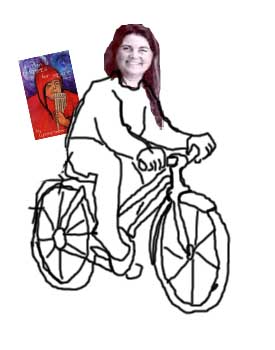 Anyone want to sponsor me? Anyone want to sponsor me?Living our dreams can be scary business. Sometimes I get nervous and even freeze in fear at what I am attempting. After all, I'm not a young rocker or a young cellist guy. I am a lone woman over 50 years old and fat. Maybe even obese (isn't that an ugly word?). But, hey, I already have followed the sound of the panpipes to the Andes, seeking the ideal society of which they sing, and wrote a novel about it. There were lots of scary moments in that journey, too. Don't believe me? Just check out the Warrior Town chapter of Lucy Plays Panpipes for Peace. When I freeze, I just make myself do something — like Daisaku Ikeda says — and take action. I answer the next email confirming a gig, pack the next box, chant nam myoho renge kyo and the fear passes. And then enthusiasm builds. From South America I fly into San Francisco, in order to visit friends, pick up my bicycle and attend the 50-year anniversary celebration of SGI Buddhist leader Daisaku Ikeda's first visit to the Americas. Then I pedal to the Amtrak station, try out my new toolkit to disassemble my bike and put it in a box as I board the train to Vancouver for the October 7 presentation at Simon Fraser University, then on to Seattle, Oregon, and California. Part of living simply, for me, is to not buy more stuff than I need. So, I am not buying panniers for my bicycle, or a bike trailer or anything like that. I will bungee cord my old backpack onto the rack and pedal to the next venue, carrying all my gear, books and musical instruments to present "Lucy Plays Panpipes for Peace, a novel" to inspire people to live their dreams. I hope to see you soon at one of the events! The calendar is constantly being updated on www.musicandes.com. Article first published as Fat old lady bicycles West Coast Book Tour to inspire you to live your dreams on Blogcritics.
Subscribe to:
Posts (Atom)
About Me
|

